 |
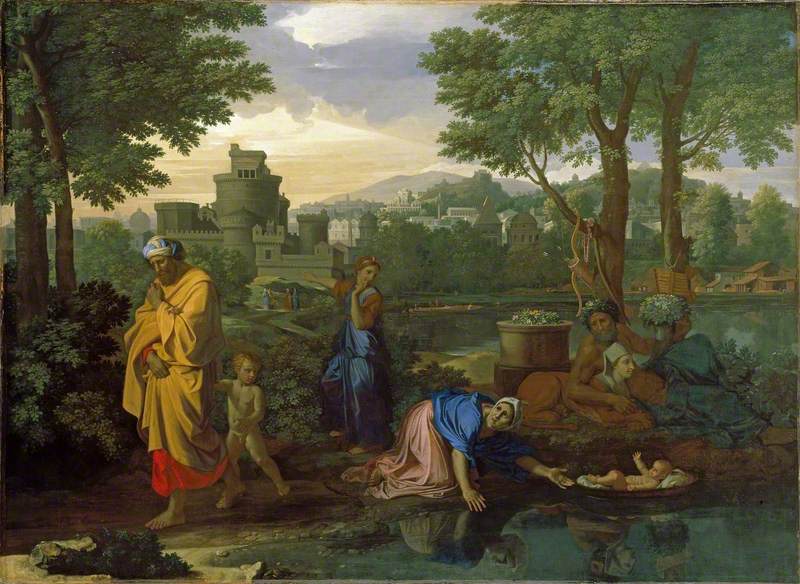
Nicolas Poussin, The Finding of Moses (1651), oil on canvas, 116 cm x 178 cm, National Gallery London and Amgueddfa Cymru - National Museum Wales. Wikimedia Commons.
|
 |
| Carlo Maratta, The Finding of Romulus and Remus (1680-92), oil on canvas, 263 x 394 cm, Bildergalerie (Sanssouci), Brandenburger Vorstadt, Germany. Wikimedia Commons. |
I've been listening to SPQR by Mary Beard. I actually didn't learn a lot of non-US history in school, so now I'm playing catchup. I would be able to recognize some basic things about the Roman empire, but anything specific is fuzzy.
Yesterday I read about the mythical origins of Rome—Romulus and Remus. It surprised me that Beard didn't bring up comparisons with Biblical stories beyond Cain & Abel (Romulus kills Remus). I found many, the most notable being the similarities between Romulus and Moses: Both were ordered to be drowned and they were saved by being put into a basket floating on the river, both had noticeably absent fathers and side-kick brothers, both founded nation-states, both were taken up to heaven instead of being buried.
I know I'm not the first person to make these connections, nor are they the only heroes of the Near East to share some of these biographical details.
I found over 20 paintings of "The Finding of Moses", and many of them were quite striking. Some were more of a landscape, others were seemingly painted to show off the queen's lace. I chose to compare the two paintings above—The Finding of Moses by Poussin and The Finding of Romulus and Remus by Maratta— because of how similar the compositions are. The protagonist, lying nude in a basket at the center of the painting. The woman receiving the baby wears a green skirt and a red wrapper. She stands center-left and faces right. The one offering the baby wears blue, and is kneeling, facing left towards the woman. To the left, behind the woman, crouches a girl in blue. In fact, we see a second, neutral figure crouching behind the woman in both paintings. In the bottom left corner we see green drapery—in The Finding of Romulus and Remus this drapery covers Mars the Tiber river god, while in The Finding of Moses it lies on a step, forgotten.
Poussin painted several versions of this scene, actually. His other variations feature two men who look suspiciously like Mars the Tiber river god and Faustulus, the shepherd who rescues baby Romulus. Who are these men supposed to be in the Moses narrative? They are absent from the Exodus record.*
*Upon some research, I learned that the naked man with the flowers represents the Nile river god. I'm still unclear who the Faustulus clone is.
 |
| Nicolas Poussin, Moses Saved from the River (1638), oil on canvas, 93.5 x 121 cm, Musée du Louvre, France. Wikimedia Commons. |
_-_Nicolas_Poussin_-_Louvre.jpg) |
Nicolas Poussin, Moïse sauvé des eaux (1647), oil on canvas, 120 x 195 cm, Musée du Louvre, France. Wikimedia Commons.
|
 |
| Nicolas Poussin, The Exposition of Moses (1654), oil on canvas, 149.5 x 204.5 cm, Ashmolean Museum, UK. ArtUK.org. |
.jpg) |
| Nicolas Poussin, The Exposition of Moses (1624), oil on canvas, 145.5 x 197 cm, Staatliche Kunstsammlungen Dresden, Germany. Wikimedia Commons. |
I found far fewer depictions of Romulus's and Moses's ascension to the heavens, but here are two.
 |
| Jean-Baptiste Nattier, Romulus being taken up to Olympus by Mars (c 1700), oil on canvas, 99 × 96.5 cm, Muzeum Kolekcji im. Jana Pawła II, Warsaw, Poland. Wikimedia Commons. |
 |
| Alexandre Cabanel, The Death of Moses (1850), oil on canvas, 140 x 204 cm, Musée Fabre, France. Wikimedia Commons. |
Out of the dozens of paintings I saw while researching all of this, the following was my favorite. Moses's mother, suspicious and watchful as she defiantly sends her son off to the Nile.
 |
| Alexey Tyranov, Moses' Mother (c 1839-42), oil on canvas, Tretyakov State Gallery, Moscow. Wikimedia Commons. |
