Pills & the Art of Medicine
I'm nearly finished reading Empire of Pain: The Secret History of the Sackler Dynasty by Patrick Radden Keefe. I've read several books about addiction and, more specifically, the opioid crisis in the United States, including:
- Tightrope by Nicholas Kristof
- American Overdose by Chris McGreal
- Dopesick by Beth Macy
- Beautiful Boy by David Sheff
I am fascinated by it all. When I was a teen growing up in Arizona in the early 2000's, the most readily available drugs that high schoolers took were weed and shrooms, and if you were crazy, meth. Everclear was the most coveted substance for parties. But for trudging through the school day, weed and Percocet that was pinched from parents' medicine cabinets were the most common. I remembered being prescribed a few days' worth of Percocet after my wisdom teeth were removed (I opted for all four out at once), and a friend remarked, "Nice, you got the good stuff." I was more excited about the prospect of unlimited fudgesicles, sugar being my stimulant of choice.
I've read op-eds in recent years stressing that kids of today are so often prescribed medications that they don't see any danger in popping illicitly acquired pills. At parties, they pool together pills and pass around the cup, like a candy-coated take on the jungle juice ritual of cheap frat parties.
Whether those tales are common or not, artists have been working with Americans' proclivity for "mother's little helper" since before I was born.
British conceptual artist Damien Hirst certainly has the corner on that market—the Purdue Pharma of the objet trouvé, if you will. I'm far too lazy to do the research, but for irony's sake I would like to know if any of his Pill Cabinets have appeared in Sackler sponsored galleries.
 |
| Damien Hirst, Pharmacy (1992), mixed media objects, variable dimensions, Tate, UK. |
Hirst's entire career is endless variations on this theme, beginning in the 1980s. Lately it has been more sensationalist with whole animals preserved in formaldehyde, but one could say he hasn't strayed too far from fanciful displays of a pharmacist's back room.
 |
| Damien Hirst, Utopia (2012); inkjet, glaze, and foilblock on Hahnemuhle photo rag satin 310gsm; 82.6 × 69.1 cm. Image from artsy.net. |
| Damien Hirst & Mark Hix, Pharmacy 2 restaurant (2016), Vauxhall, London. Image from Business Insider. |
The pop-art colors of the pills instantly remind me of Félix González-Torres's piles of candy. They come in different mixed-color schemes, but are always abundant and viewers are encouraged to "participate" in the art. Much of González-Torres's art is devoted to the memories of friends and partners lost to AIDS. While the meaning of the bright, sparkly sweets that melt away all too soon is not lost on me, I think of another meaning: how wonderful it would have been if the AIDS epidemic could have been treated with something as simple as a pill you pop in your mouth.
_by_Felix_Gonzalez-Torres.jpg/1593px-%22Untitled%22_(Portrait_of_Ross_in_L.A.)_by_Felix_Gonzalez-Torres.jpg) |
| Félix González-Torres, “Untitled” (Portrait of Ross in L.A.) (1991); candies individually wrapped in multicolor cellophane, endless supply; dimensions vary - 175 lbs.; Art Institute of Chicago. Wikimedia Commons. |
Speaking of readymades and pharmacies, Marcel Duchamp led the way (again!) with his Pharmacie. He added two drops of color, inspired by the colorful pill bottles commonly seen in pharmacy windows of his time, and signed his name to another's drawing. This act probed at questions of authorship, authority, the institution and the core of what art is. Duchamp made endless variations and examples of art that asked cheeky questions about itself—inspiring all of 20th century art in the West.
 |
| Marcel Duchamp, Pharmacie (1914/1945), 22 x 15.6 cm. |
 |
| Francis Picabia, Phmarcie Duchamps (1920), gouache and ink on paper, 25.2 x 32.2 cm. Image from Christie's. |
 |
| Joseph Cornell, Pharmacy (1943), box construction, 38.7 × 30.5 × 7.9 cm, Royal Academy of Arts, London. Image from Artsy. |
"For Hirst medicine, like art, provides a belief system which is both seductive and illusory. He has commented: ‘I can’t understand why some people believe completely in medicine and not in art, without questioning either.’" (Source)
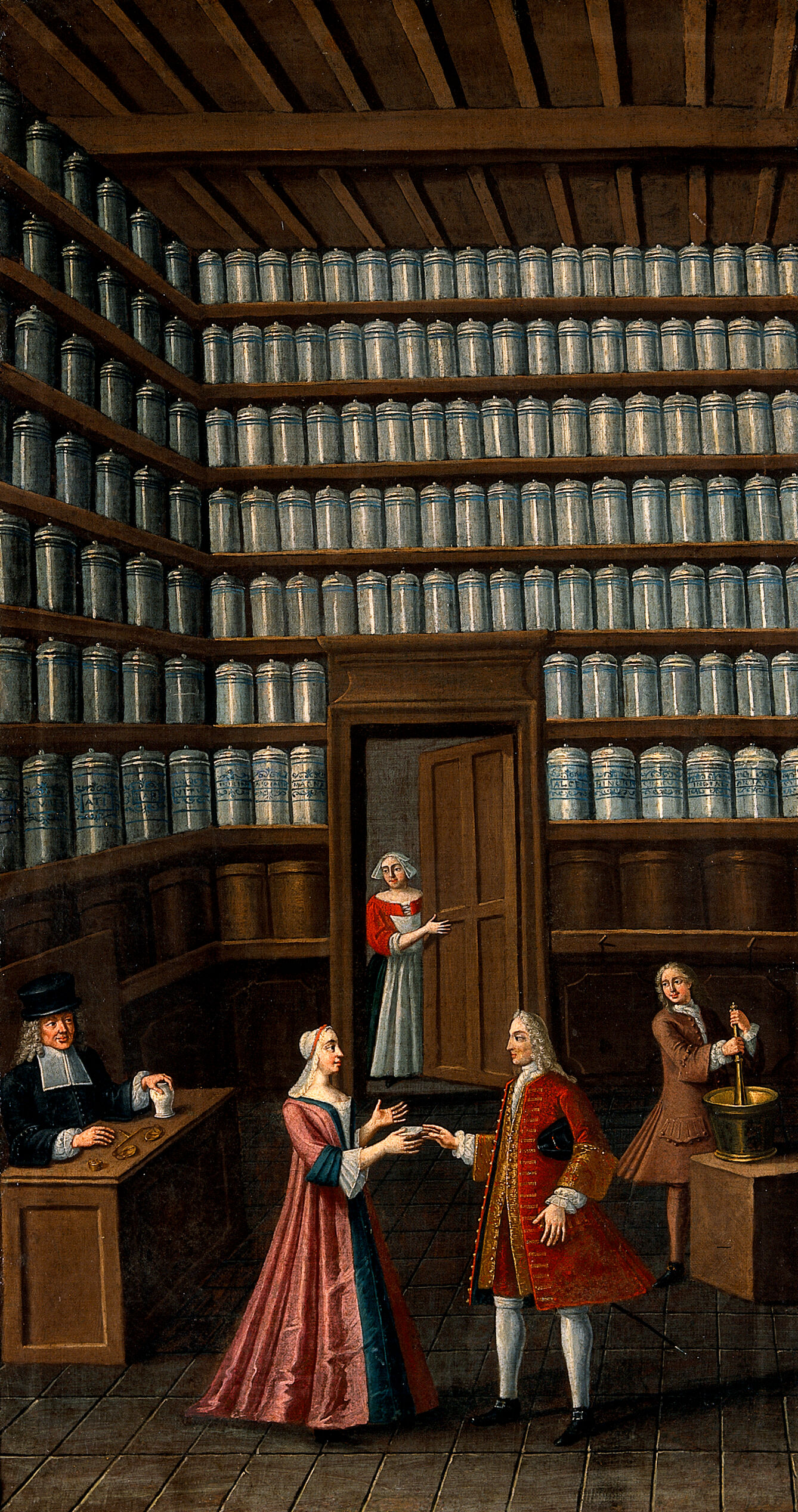 |
| unknown French artist, A Pharmacy (ca 1700), oil on canvas. Wellcome Library, London. |
